For many of us, the lure of the beach is undeniable. The thing is, when you’re a wheelchair user the golden, soft shifting sands can be a challenge.
That’s where beach wheelchairs come in. They’re specially designed to help people successfully navigate sandy terrain. If you fancy building your own, you can check out my post on ‘How to make a beach wheelchair.”
Today though, I’ll focus on where you can rent or hire one and how much it costs. I’ll also ask how you can get a wheelchair through sand, and if beach wheelchairs are difficult to push. Later on, I’ll give you a list of beaches that have beach wheelchairs you can use. I’ll also discover what a floating beach wheelchair is. First, though, let’s answer today’s main question.
Beach wheelchair rental costs typically range from $20 to $50 per day. Prices may differ based on location and services. Some beaches offer complimentary rentals so it’s worth checking with local authorities for the most up-to-date information.
The cost of renting a beach wheelchair can vary depending on the location and the rental service. Prices and policies can change, so it’s best to get in touch with the specific rental service you’re using to get the most accurate, up-to-date information.
How do you get a wheelchair through sand?
Moving a wheelchair through sand can be challenging because sand can create resistance, especially when it’s loose and shifting. That being the case, how do you deal with sand as a wheelchair user? Here are some tips, beginning with an obvious one.
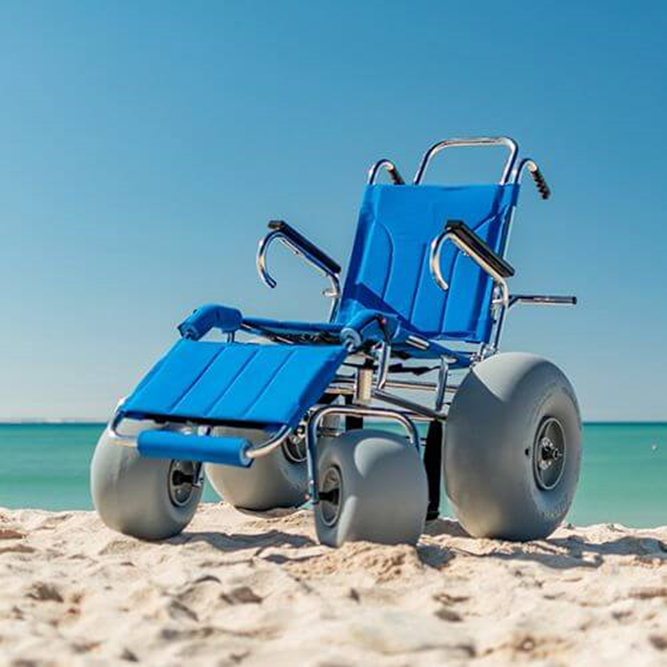
Use a beach wheelchair – Consider using a beach wheelchair designed to move across the sand. These wheelchairs typically have larger, wider wheels with treads that help distribute the weight and stop you from sinking into the sand.
Attach beach-friendly wheels to your chair – If you’re using your own wheelchair, it might be a good idea to attach some beach-friendly wheels. These may have broader surfaces or inflatable tires that give you better traction on sand.
Reduce tire pressure – If it’s possible with your wheelchair, you can try slightly reducing the tire pressure. This can increase the surface area in contact with the sand, and therefore make it easier to push.
Ask for help – Enlist the help of a friend or family member to help you push the wheelchair. Having an extra set of hands can make it easier to cope with sand.
Avoid dry or loose sand – Whenever possible, choose paths with firmer, wetter sand because it gives you more stability. Dry, loose sand is more of a problem because you’re more likely to sink into it and get stuck.
Angle and pivot – Approach inclines or obstacles at a slight angle rather than head-on. This can reduce resistance and make it easier to move through the sand. Pivoting the wheelchair when needed can also help.
Use a beach mat or board – Some beaches provide you with mats or boards that make it easier to roll a wheelchair over the sand.
Make a plan – It’s always a good idea to plan before heading to the beach and find out what the beach can offer you in terms of accessibility. For instance, they might have beach wheelchairs you can rent or designated paths you can use.
If at any point you’re unsure about something or need help, don’t be afraid to ask questions. After all, your safety and comfort are of paramount importance.
Are beach wheelchairs hard to push?
Beach wheelchairs are specially designed to cross sand, therefore they’re easier to push on the beach compared to standard wheelchairs. They usually have large, wide wheels with treads that can move over sand more effectively. This helps distribute weight and prevents the wheelchair from sinking into the sand.
It should be noted the exactly how easy it is to push a beach wheelchair can also depend on the type of sand you’re dealing with, the person pushing the wheelchair, and the specific design of the beach wheelchair.
Therefore, you should always choose a beach wheelchair that’s suitable for you and your needs. Try out different models to find one that’s comfortable and easy to use.
Next, let’s find out more about the beaches around the world that offer beach wheelchairs to rent.
Which beaches have beach wheelchairs?
The availability of beach wheelchairs varies according to where you are, nonetheless, many popular beaches around the world offer beach wheelchairs you can rent. Let’s look at some of them.
- Santa Monica Beach, California, USA – Offers free beach wheelchairs to rent through Perry’s Café.
- Bondi Beach, Sydney, Australia – Three kinds of beach wheelchairs are free to use. The Sandcruiser, an adult-sized wheelchair, The Sandpiper, a child-sized wheelchair and the Mobi-chair helps you float in the water. You must plan ahead and book one of these for your visit by contacting Waverly Council.
- Miami Beach, Florida, USA – Offers both manual and motorized beach wheelchairs you can use for free to help you get around. They also have designated beach access points for wheelchair users.
- Waikiki Beach, Hawaii, USA – Offers free beach wheelchair rentals.
- Brighton Beach, England – Provides access to beach wheelchairs during the summer months.
- Ipanema Beach, Rio de Janeiro, Brazil – Can access beach wheelchairs at some locations.
- Grand Bend Beach, Ontario, Canada – Offers free beach wheelchair rentals in summer.
- South Padre Island, Texas, USA – Provides access to beach wheelchairs through local rental services.
- Torre del Mar, Costa del Sol, Spain – This is an accessible beach, with amphibious chairs available.
- Mallorca, Spain – Some beaches in Mallorca offer beach wheelchair rentals.
- Acapulco, Mexico -Some beaches in Acapulco offer beach wheelchair rentals.
As with anything, if you’re unsure what services a particular beach offers, contact them directly for the most accurate, up-to-date information.
It’s time to find out about floating beach wheelchairs.
What is a floating beach wheelchair?
A floating beach wheelchair, sometimes called an amphibious wheelchair, is a specialized wheelchair designed to provide people who are less mobile the chance to enjoy the water at either the beach or at swimming pools. Unlike traditional wheelchairs, floating beach wheelchairs are equipped with features that allow them to float and move in water.
Floating wheelchairs are typically:
- Made from buoyant materials.
- Made from corrosion-resistant materials.
- Have balancing mechanisms that help improve stability in water, so that the user feels safe and secure.
- Have big wheels to help you move through sand and move around in the water.
- Have support and straps to help the user feel more secure when in the water.
These wheelchairs are available at certain accessible beaches and aquatic facilities, and they can significantly enhance the overall beach experience for disabled people.
Let’s look at some alternatives to beach and amphibious wheelchairs in case you don’t have access to one on the beach you want to visit.
What are some alternatives to beach wheelchairs?
While beach wheelchairs are specifically designed to navigate sandy terrains, there are some alternative options that can help everyone enjoy a visit to the beach.
All-Terrain wheelchairs – These have bigger wheels and robust designs, making them suitable for various terrains, including sand.
Power wheelchairs – Some power wheelchairs are designed with off-road capabilities, allowing users to navigate through sand, gravel, and other challenging terrains.
Beach or sand walkers – Beach walkers have wide, sturdy bases that provide stability on sand. They often have handles for support and can be a good alternative for people who can walk short distances.
Mobi-Mats and accessible paths – Some beaches install Mobi-Mats or accessible paths made of durable materials that make it easier for wheelchair users to move across the sand.
Help from a friend – Having a friend help you out can be a practical alternative. This may involve someone pushing a wheelchair or offering support as needed.
Beach carts or wagons – Beach carts or wagons with large, inflatable wheels can be used to transport individuals with mobility challenges across sandy beaches. They are not wheelchairs but can assist in mobility.
Wrap up of: How much does it cost to rent a beach wheelchair?
Finding out how much it costs to rent a beach is about more than simply discovering if it’s a viable option for you. It also shows a commitment to breaking down barriers and making beaches accessible for all. From the sandy expanses of the beaches in Mallorca, to the crowds at Brighton Beach, the increasing availability of beach wheelchairs seems to be a step in the right direction.
While the price tags on these rentals vary, the doors they open and the opportunities they can afford to disabled people are limitless. They provide a way for people with mobility difficulties to enjoy the sea and sand along with everyone else and make some beautiful memories. Thus, the true worth of a beach wheelchair extends far beyond its cost, it lies instead in the joy it can bring to many people. So next time you’re at the beach, why not rent one for yourself and make your visit that much more enjoyable?
As always, thanks for reading.